
ADHD COACHING vs. THERAPY
Which One Is Right For Me?
ADHD: Threat or Asset to Society?
People build societies based on shared cultural values, which help create a sense of belonging and connection. However, when differences in beliefs or customs arise, they can be seen as threats to this shared identity.
This often leads to a tendency to minimize or even penalize diversity in favor of “sameness,” which is mistakenly associated with safety. As a result, those who stand out may face social rejection or discrimination, stifling their creativity and personal expression.
Throughout history, individuals with ADHD have shown remarkable strengths, especially in challenging situations. In ancient times, they were often excellent hunters because of their ability to focus and react quickly.
Today, many people with ADHD thrive in demanding jobs, such as CEOs who benefit from their innovative ideas or first responders who utilize their quick thinking in high-pressure situations.
ADHD is a unique part of human diversity that comes with both challenges and valuable strengths.
Individuals with ADHD frequently show heightened creativity, strong problem-solving abilities, and a knack for thinking outside the box. In supportive environments, these traits can lead to innovation and meaningful contributions.
By recognizing and embracing the strengths associated with ADHD, we can turn challenges into opportunities for success and creativity.

What Is ADHD
Everything you think you know about ADHD is WRONG.
The name — Attention Deficit Hyperactivity Disorder — isn’t a diagnosis; it’s an insult.
It stems from a simplistic perspective, where people concentrate on labeling behaviors instead of understanding their underlying causes.
This narrow perspective oversimplified a complex issue and labeled behavioral differences as disorders.
The consequences include years of rejection, shame, and punishment for how individual bodily systems work.
It taught society to undervalue brilliance that operates on Quantum voltage in a Newtonian world.
That ends here.
SYSTEMS RESOURCE ALLOCATION SYNDROME
ADHD (SRAS) is not a behavior problem.
It isn’t a motivational failure.
And it’s sure as hell not a character flaw.
It’s the predictable result of your body’s systems competing for resources.
ADHD—what we call Systems Resource Allocation Syndrome (SRAS)—is an ADAPTATION, not a defect.
To foster a more nuanced understanding, we will add "SRAS" to every mention of ADHD, encouraging a constructive dialogue around this issue.
Biology—not bad habits—provides the primary explanation for how our bodies function. The human body is a complex machine made up of complementary systems that work together. These systems rely on resources to operate optimally.
Ideally, a sufficient supply of resources would always be available. However, in reality, body systems compete for limited resources and strive to maintain balance among focus, emotion, and energy.
When key players—such as neurotransmitters, hormones, and nutritional elements—are out of sync—whether it’s too much or too little, or if they are metabolized too quickly or too slowly—your brain doesn’t fail; instead, it adapts and adjusts its operation based on the resources available.
The fluctuations of resources outside the optimal range can lead to a system that can spark brilliance one moment and then stall completely the next.
This dysregulation creates challenges across various aspects of human functioning:
Executive Function: Difficulties with planning, prioritization, organization, time management, and impulse control.
Emotional Regulation: Increased reactivity, frustration, sensitivity to rejection, and inconsistent recovery from mood fluctuations.
Cognitive Performance: Variable attention, memory lapses, and trouble maintaining sustained focus.
Physical and Motor Systems: Restlessness, coordination challenges, and disrupted perception of time and space.
Social and Relational Functioning: Impulsive communication and difficulties with consistency or feeling overwhelmed in complex social situations.
Health and Lifestyle: Instability in sleep patterns, fluctuating motivation, and irregular stress responses.
Disclaimer
Systems Resource Allocation Syndrome (SRAS) is a conceptual framework developed by Hyper Refinery™ to describe ADHD through a systems-based, neurobiological lens. It is not a medical diagnosis, nor a replacement for one. The perspectives shared here are intended for educational and professional development purposes only and should not be interpreted as medical advice. Individuals seeking evaluation, diagnosis, or treatment for ADHD—or any related condition—should consult a qualified healthcare provider or licensed medical professional.

“Life isn’t about finding yourself. Life is about creating yourself.”
When you finally see ADHD (SRAS) for what it is—an Adaptation, not a deficit in worth—you stop letting Society tell you who you have to be.
—George Bernard Shaw
The Untapped Advantage: Neuro-Optimized Leverage
The ADHD neurotype offers powerful, often underutilized advantages. While individuals with this neurobiological structure may struggle with routine compliance, they excel in dynamic and high-pressure situations.
Adults with ADHD possess intrinsic strengths, including:
A strong capacity for divergent thinking and innovative problem-solving
The ability to achieve deep immersion through hyperfocus on engaging topics
Exceptional resilience developed from constantly adapting to systemic challenges

What Is ADHD Life Coaching
For the Brilliant, Determined, & Often Frustrated Individuals Eager For Meaningful Change
A true ADHD coach is a specialist—someone with in-depth training to understand the science, systems, and lived experience of ADHD at a holistic level.
Why a Specialist?
(Because “Just Try Harder” Is Terrible Advice!)
Most of the world’s advice is written for neurotypical brains. That’s like handing a fish a bicycle manual and getting annoyed when it can’t ride. We’re not going to slap another planner in your hand and call it a day.
Think ADHD coaching is just for people who can’t function?
Think you just need a better (digital, colorful, self-winding, AI-powered) productivity hack?
Think you just need more discipline?
Most of my clients come to me feeling like they’re “failing” at life. But here’s the truth: ADHD isn’t a deficit—it’s an adapted operating system. Once you learn how to use it, everything changes.
WHAT IS ADHD LIFE COACHING?
The Coaching Process: A Journey Toward Systemic Change
ADHD Life Coaching is the active verb of change you’ve been looking for—the essential next step after diagnosis and self-discovery.
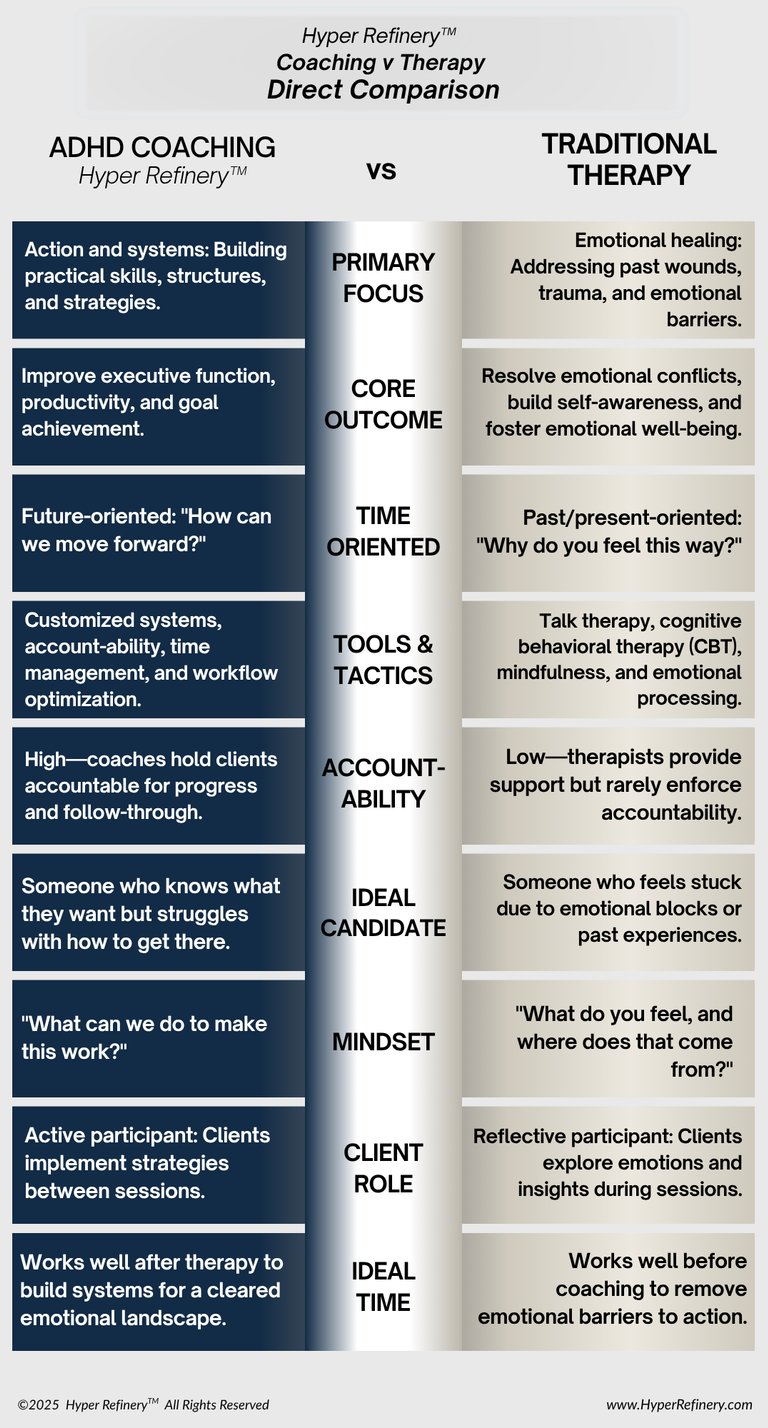
ADHD life coaching is a specialized form of life coaching that helps individuals with ADHD understand their unique neurodivergent brain and develop personalized strategies to manage daily challenges and achieve their goals. It is a collaborative, action-oriented process, but is distinct from therapy, which focuses on emotional healing.
ADHD coaches collaboratively design personalized systems with their clients that align with strengths, rather than forcing clients to falter with generic tools.
The Hyper Refinery™ ADHD coaching protocol is a dynamic and personalized partnership designed to bridge the gap between potential and consistent execution.
We provide structured accountability to develop executive function skills, leading to improved focus, time management, organization, and follow-through.
To ensure this powerful transformation, it is imperative to engage a coach who is specifically trained by an accredited program.
This specialized expertise guarantees they not only deeply understand the unique daily challenges you face but are also distinctively equipped to recognize and leverage the extraordinary depth of your brilliance and potential.
Having an ADHD coach with specialized training is crucial because they understand the unique aspects of ADHD and can offer tailored strategies. A general life coach might overlook specific executive function challenges, resulting in ineffective strategies and frustration. Specialized training enables ADHD coaches to address issues like time blindness, emotional dysregulation, and task initiation more effectively.
Here are the key reasons why specialized training is crucial for an ADHD coach:
A neurodiversity-informed coach sees ADHD as a unique brain wiring rather than a deficit. This strengths-based approach helps clients recognize their behavior patterns without judgment, promoting self-acceptance. In contrast, general coaches might adopt a deficit-based view, potentially harming a client’s self-esteem and fostering shame.
Targeted strategies: Specialized training equips coaches with ADHD-specific tools to address hyperfocus, motivation, and distractibility. While a general coach might recommend a calendar, an ADHD coach creates a personalized visual system for managing time and tasks, considering "time blindness."
People with ADHD often experience co-occurring conditions like anxiety and depression. Specialized ADHD coaches can recognize these issues and offer support or referrals to licensed therapists when needed, unlike general coaches who may lack this training.
Accountability that works: A specialized ADHD coach offers tailored accountability, understanding the motivational challenges related to dopamine regulation. They provide supportive, empathetic guidance for follow-through, while a non-specialized coach may use an ineffective surveillance-like approach.
Vetted credentials: The coaching profession is largely unregulated, allowing anyone to call themselves a coach. Hiring one trained in an accredited program ensures they meet high standards for expertise and ethics, protecting clients from unqualified individuals.
A neurodiversity-informed approach reframes neurological differences like ADHD by viewing them as natural variations in human cognition rather than as impairments to be fixed. This perspective emphasizes individual strengths and supports unique ways of thinking, rather than trying to suppress differences.
Working With A Neurodiversity-Informed Approach
Monday Morning, 8:15 AM
You pour yourself that first cup of hot coffee with a shot of enthusiasm. Today is the day, you think. I will tackle that Task list! Or at least make a real dent in it. You sit down at your computer, ready to conquer the world—or at least your inbox.
Fast Forward to 5:47 PM
Somehow, your web browser now has 27 tabs open. Your email inbox glares at you with 383 unread messages, and your calendar, which looked so orderly this morning, has filled with relentless, back-to-back meetings—some productive, some soul-crushing, all leaving you wondering where the hell the day went. And that Task list? It’s still there, untouched and mocking you.
When you have ADHD, you’ve spent your life hearing—or telling yourself—some version of “Just try harder,” “Why can’t you focus?” or “You’re so smart—why is this so hard for you?” And if you’re like most of my clients, you’ve internalized that as “I’m broken.”
Why a Specialist?
(Because “Just Try Harder” Is Useless Advice)
Most of the world’s advice is written for neurotypical brains. That’s like handing a fish a bicycle manual and getting annoyed when it can’t ride. We’re not going to slap another planner in your hand and call it a day.
“Here’s how we write your Hyper Refinery™ Operating Manual.”
We decode your ADHD. We map out where, when, and how your ADHD shows up—so we can stop fighting it and start activating your strengths.
We outfit your toolbox with customized tools that work for you—and teach you how (and when) to use them. (If necessary, we’ll also teach you when to throw them out!)
We focus on your strengths, not your failures. We celebrate the wins (even the tiny ones) and track progress in a way that matters to you—not some arbitrary standard.
We make it sustainable. ADHD brains thrive on novelty, interest, and urgency. We’ll design habits that feel good—so you’re not white-knuckling your way through life.
Myths Exposed
Think ADHD coaching is just for people who can’t function?
Wrong. My clients are CEOs, parents, creatives, and high-achievers who are tired of feeling like they’re failing despite their success.
Think you just need a better (digital, colorful, self-winding, AI-powered) productivity hack?
Nope. It’s a matter of understanding why productivity feels hard—and finding ways to make it effortless (or at least less painful).
Think you just need more discipline?
No way. Discipline is just another word for control—a word used by neurotypicals to force you to operate in a way that works best for them. Your genius operates best with the freedom to follow your energy, creativity, rest cycles, and your own rhythm. We teach you to map and honor the way you work best.
The Best Part?
You’ll Start Trusting Yourself.
Most of my clients come to me feeling like they’re “failing” at life. But here’s the truth: ADHD isn’t a deficit—it’s a different operating system. Once you learn how to use it, everything changes. You’ll:
Stop apologizing for how your brain works.
Design a life that fits you (not someone else).
Walk away with the confidence and self-esteem to recognize your own wins—no cheerleader required.
Ready to turn your potential into performance?
No guilt. No shame. Just customized science-backed solutions that work.
--Laura (ADHD Specialist, Founder Hyper Refinery™, Your Partner of Precision & Impact)

Coaching Isn't Therapy, But It Is Therapeutic
WHAT IS THERAPY?
Traditional therapy, or counseling, is a teamwork process where a person works with a licensed mental health professional to address emotional, mental, and behavioral issues.
The Focus: Past, Insight, and Healing
Traditional therapy tends to be backward-looking and diagnostic, focusing primarily on deep psychological healing and insight.
Excavation and Insight: Exploring the client’s past experiences, history, and relational patterns to understand their impact on current feelings and behaviors.
Emotional Processing: Navigating intense emotions, resolving internal conflicts, and alleviating psychological symptoms like depression, anxiety, or trauma.
Safe Space: Similar to coaches, therapists provide a safe, non-judgmental, and confidential environment where clients can explore their vulnerabilities and difficult topics.
Diagnosis and Mental Health: Often focused on satisfying clinical diagnosis criteria (e.g., General Anxiety Disorder, Major Depressive Disorder) and delivering interventions based on established mental health practices.
The Therapeutic Process
Therapy is usually a long-term process focused on gaining depth and understanding.
Relationship as Tool: The therapeutic relationship itself is a key component of healing, allowing the client to model healthier relational styles and test new emotional responses.
Deep Change: The goal is to transform psychological and behavioral patterns by altering the internal narrative, processing trauma, and enhancing the client's self-relationship.
In essence, therapy addresses the root cause of the cracks in the foundation. Hyper Refinery's coaching protocol is dedicated to a holistic methodology of architecting a new, optimized system for sustained, high-performance output. Your timeless legacy awaits. Let's begin.
The goal is to help individuals feel more balanced and improve their overall quality of life by exploring and understanding the causes of their difficulties.

Coaching or Therapy
Which Protocol Best Serves Your Ambition?
Therapy often delves into the past, untangling roots and healing wounds. It’s invaluable for recovery and emotional growth. It’s a deep dive into your past, analyzing, unpacking, and sorting through the mental storage unit of your life.
ADHD coaching means taking action. Chances are, you’ve already tried countless systems for time management, organization, scheduling, and productivity—and when they didn’t work, you might have blamed yourself.
That’s great if you’ve got some emotional hoarding going on. Therapy’s approach is largely introspective and retrospective, aiming to help clients gain insight into how their past influences their present.
Coaching allows you to tap into systems built for the way your mind works. ADHD coaching targets the here and now to build a better future.
Know When to Seek Immediate Help
If you are experiencing severe distress, thoughts of self-harm, or symptoms that are significantly impacting your daily life, it's crucial to reach out to a mental health professional immediately. If you are experiencing a life-threatening medical emergency, call 911 immediately.
"That’s great if you’ve got some emotional hoarding going on. "
EXECUTIVE DECISION PROTOCOL
As a high-performing professional, you know the difference between a small setback and systemic friction that threatens your entire workflow.
Hyper Refinery™ Coaching vs. Therapy Complexity Assessment
This focused assessment will analyze your patterns of response to executive challenges, providing the unfiltered clarity you need to choose the right path for your next level of achievement.
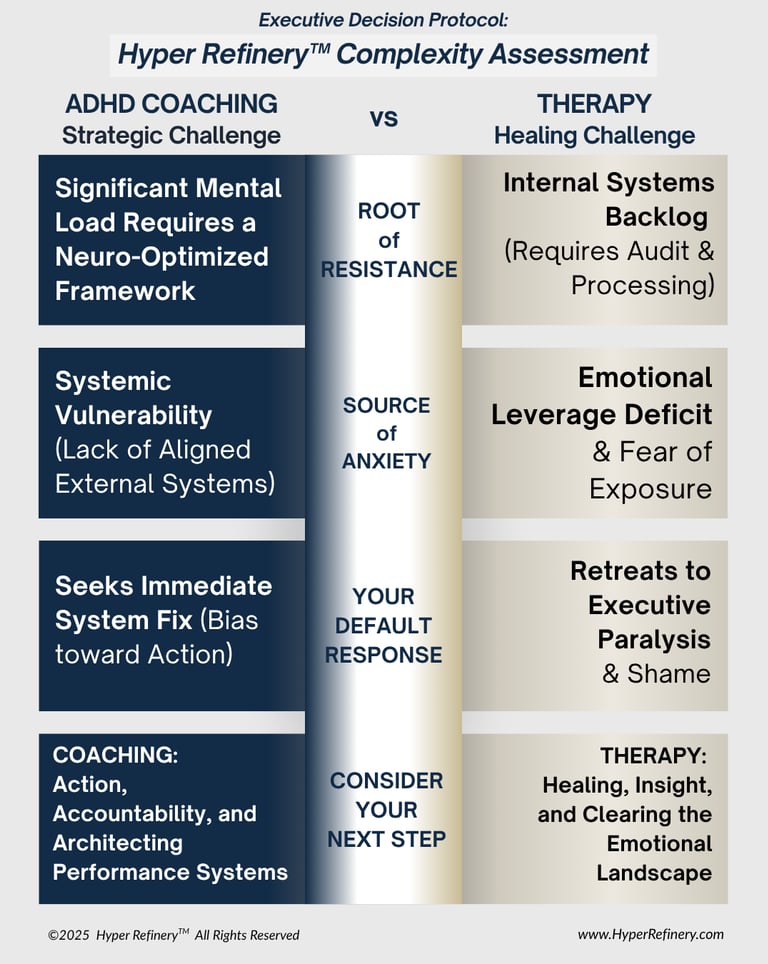
The essential question is not if you're struggling, but why: Is your inconsistency rooted in a systems failure that requires strategic action (Coaching), or an emotional wound that requires healing and insight (Therapy)?
Start your Legacy Expedition with an accurate assessment of the complexities you deal with personally.
Disclaimer: This assessment is for informational purposes only and is not a substitute for a professional mental health assessment or diagnosis. If you are experiencing severe distress or a mental health condition, please consult a licensed mental health professional.
Hyper Refinery™ Coaching vs. Therapy Complexity Assessment
ACCESS
EXECUTIVE DECISION PROTOCOL
BELOW

Know When To Get Immediate Help
If you are experiencing severe distress, thoughts of self-harm, or symptoms that are significantly impacting your daily life, it's crucial to reach out to a mental health professional immediately.
If you are experiencing a life-threatening medical emergency, call 911 immediately.
988 Suicide & Crisis Lifeline
The main contact for anyone needing urgent mental health help for themselves, a family member, or a loved one.
Veterans and military service members can press 1 after dialing 988 to be connected to the Veterans Crisis Line.
Call or text 988 to connect with a trained counselor who can provide confidential, free, and 24/7 support for a range of issues, not just suicide.
Chat online by visitng 988lifeline.org/chat.


Revolution Ignites Refinement
Hyper Refinery™
The Refinery Protocol™ forges sustainable clarity, structure, and performance — one deliberate step at a time.
Schedule a focused 20-minute Initial Consultation to explore whether our partnership is the right fit for your next evolution.
Every revolution begins with a single endeavor.
This one starts with a conversation.



Office
3505 Pelham Road, Suite B
Greenville, SC 29615-4154
Contact
Support@HyperRefinery.com
+1 864.695.1025


Some images on this site are AI-generated representations.
© 2026 Hyper Refinery. All Rights Reserved.